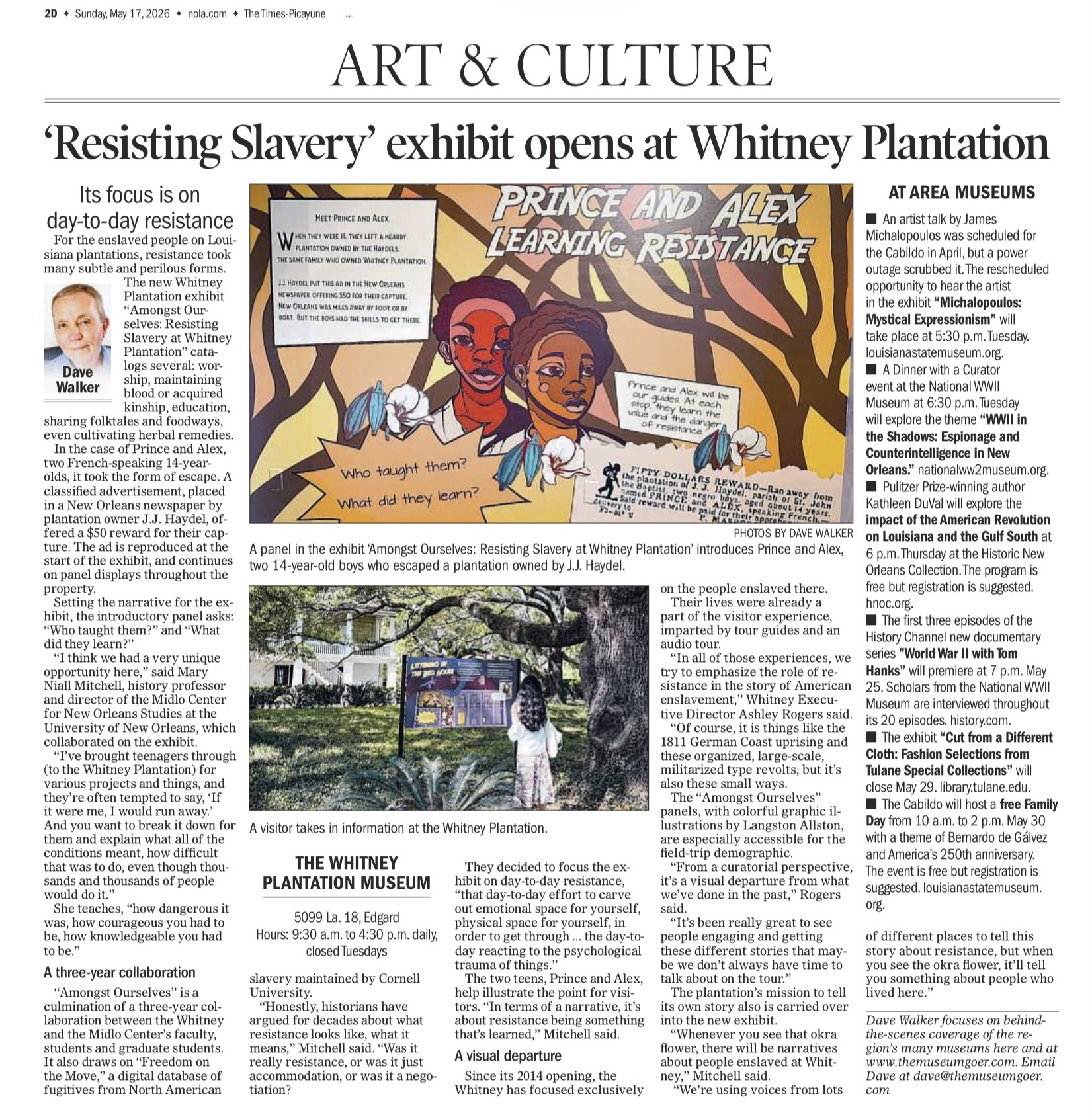
“Amongst Ourselves: Resisting Slavery at Whitney Plantation,” with wonderful graphic illustrations by Langston Allston, is a collaboration between the Whitney and Midlo Center for New Orleans Studies at the University of New Orleans faculty, students, and graduate students. “Amongst Ourselves” also draws on “Freedom on the Move,” a digital database of fugitives from North American slavery maintained by Cornell University.
“I think we had a very unique opportunity here,” said Mary Niall Mitchell, director of the Midlo Center and a UNO history professor. “I’ve brought teenagers through here for various projects and things, and they’re often tempted to say, ‘If it were me, I would run away.’ And you want to break it down for them and explain what all of the conditions meant, how difficult that was to do, even though thousands and thousands of people would do it.”
To teach, Mitchell added, “how dangerous it was, how courageous you had to be, how knowledgeable you had to be.”
For the enslaved on Louisiana plantations, resistance took many subtle and perilous forms. The exhibit catalogs several: worship, maintaining blood or acquired kinship, education (especially literacy, the teaching of which to the enslaved was a crime in most Southern states), sharing folktales and foodways, even cultivating herbal remedies.
In the case of Prince and Alex, two French-speaking 14-year-olds, it took the form of escape. We know because of a classified advertisement, placed in a New Orleans newspaper by plantation owner J.J. Haydel, offering a $50 reward for their capture. The ad is reproduced at the start of the exhibit, which continues on panel displays throughout the property.
Setting the narrative for the exhibit, the introductory panel asks: “Who taught them?” and “What did they learn?”
Coverage continues in the Times-Picayune here. Here is a podcast interview on the grounds with Mitchell and Ashley Rogers, the Whitney’s executive director. A few photos are below.